
Evolution of V2G: CPOs-Automotive OEMs-Utilities at the center of transition
About the Whitepaper
V2G technology, despite being in its early stage, is expected to alter not only the electric vehicle (EV) market, but the entire electricity market as well. So far, one of the biggest hurdles to V2G adoption has been a lack of V2G standard. However, with CharIN promising a new standard in 2025 and Automotive OEMs joining NACS (North America Charging Standard) in the USA, the landscape of V2G is going to drastically change very soon.
In this whitepaper, we take a deeper look at the possible use-cases leading to new revenue streams from V2G, key stakeholders (Automotive OEMs, Utilities, CPOs) trying to get a share of that revenue, and several simulated scenarios where one of them potentially leads the V2G space and can capture majority of this opportunity. The sections of the whitepaper include:
Overview of V2G Technology Today
- Growth of DC EV Chargers Globally
- Emergence of V2G as a Technology
- Regulations Enabling V2G Integration
Use-Cases of V2G and Their Importance
- Renewable Curtailment Reduction
- Capacity Firming
- Frequency Regulation
- Congestion Management
Key Stakeholders in the V2G Space
- CPOs/MSPs
- Utilities
- Automotive OEMs
Simulation Scenarios – Looking Ahead
- CPOs manage V2G as the sole aggregator
- Automotive OEMs control user’s V2G experience as an aggregator
- Utilities acting as a sole aggregator controling the V2G evolution
Related Articles
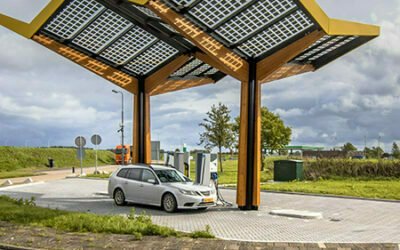
APAC’s Biggest Economies Paving the Way for EV Adoption
Even though China is the forerunner in the EV charging infrastructure, the rest of the APAC (Asia Pacific) countries are not lagging far behind. Japan and South Korea are also amping up their EV charger deployment rate by incentivizing EVs. While Australia and India...

U.S. Bipartisan Infrastructure Law – EV Infrastructure Funding
The U.S. Department of Transportation and Energy announced $5B in funding as part of the new scheme,‘National Electric Vehicle Infrastructure (NEVI) Formula Program’ which builds on the already designated Alternative Fuel Corridors. NEVI Formula funding is to be used...
Japan’s EV Infrastructure Landscape
[ba_advanced_divider active_element="text" title="EV Charging Infrastructure Service Overview" border_style_classic="solid" border_color="#6aba71" border_weight="2.4px" border_offset="6px" content_alignment="left" _builder_version="4.21.0" _module_preset="default"...
Related Articles

Electric Light Duty Vehicle (LDV) Sales More Than Double in 2021: Auto Industry Investments Bear Fruit
• E-mobility can contribute significantly to environmental and climate protection as it reduces dependence on the imports of fossil energy sources, owing to its greater use of renewable energies and its enhanced energy efficiency. • The sales of electric passenger...
Reliability Issues in EV Charging Infrastructure: A Barrier to Commercial Success
• The commercial success of the electric vehicle will require the development of a charging infrastructure that is accessible, easy to use, and relatively inexpensive• Looking at key performance indicators, which have a direct impact on a charging station's downtime,...

EV Charging Infrastructure Conference: Key Developments, Trends and Insights in the EV Charging Market
Asia Pacific EV Charging Infrastructure conference was held on 8th-9th February in Singapore. The theme of the conference centered around highlighting the key developments and improvements of electric vehicle charging infrastructure around the world with a specific...

Net-Zero Commitments Encouraging Growth in Carbon dioxide Removal Technologies
Carbon removal may be achieved through nature-based methods or by employing certain technologies, such as CCS and DAC. The drive to net-zero has resulted in enhanced interest and investment in CCUS. Carbon removal technologies should act as supplements, not...